I flew to Kuala Lumpur on December 21st, leaving the cold and rainy weather in Shanghai behind and landing hours later in Malaysia’s tropical heat and humidity. All the shopping malls were decorated with trees and lights for Christmas. Even in a tropical, majority Muslim country, shops make a huge effort to deck the halls with tacky Christmas decorations.
I explored a lot of the city on foot. Although it's very international compared to what I'm used to in Nanjing, it's a small and quiet city. It's pretty compact and has only 1.5 million people, which would put it somewhere between a big town and small city in China.
The coolest part was the diversity of the city. About 60% of the population is ethnic Malay and roughly the same number of people are Muslim. There are also a large number of ethnic Chinese, Indians and other Southeast Asian people, in addition to a good number of tourists. The food, dress and shopping was all very diverse, too. Just blocks away from huge malls with western brands is a Chinatown with restaurants serving familiar cuisines from many parts of China, especially Hainan Island, Guangdong, Hong Kong and other parts of southern China. There are lots of stalls selling knockoff goods, too.
A short walk from the China town is a neighborhood known as Little India. Restaurants serving all kinds of Indian food, gold shops, and bazaars with Bollywood DVDs and housewares. There's even a Burmese and a Nepalese area. It was cool to be able to walk from India to China to Nepal within 20 minutes.
I walked around most of the neighborhoods in the city center and made sure to visit the Petronas Twin Towers. The two skyscrapers overtook the Willis Tower (formerly known as the Sears Tower) as the tallest buildings in the world when they were finished in 1998. In person the buildings are underwhelming because they don't seem that tall. They're very skinny and taper at the top. The highest floor is the 88th floor, while the Willis Tower has 108 floors. The Petronas towers are taller because they have tall spires, which are an integral part of the building's architecture thus it counts as part of the building’s height, whereas antennas that are added on for purely functional reasons are not counted when counting the building's height.
My mom and her cousin Patrick Delahunt arrived mid-day on the 24th and we went to an Indian restaurant for a really tasty, all vegetarian meal. The food and Patrick's stories of travelling in India for a month in the early 1990s got us excited to visit India in April this year. After lunch we meandered towards the Petronas towers (I was there early that morning to wait in line for one of the 1000 tickets given out to visit the sky bridge that connects the two towers about midway up. I think I was number 1003 in line and just missed getting a ticket. We had a fun time in the mall at the base of the towers and bought ourselves some Christmas presents -- brightly colored socks from Uniqlo.
We spent our Christmas Eve on a cramped Air Asia flight (the tickets on Air Asia are cheap and you get what you pay for, tiny seats and no free food or drinks). Once we arrived, we got a couple million Indonesia rupiah (it’s just over 9,000 rupiah to the dollar so about US $110 is one million rupiah), and paid $25 for 30-day Indonesian visas.
When we went looking for a taxi, all the taxi drivers said that they didn’t know where the hotel we had booked online was located. They said they didn’t recognize the street and we didn’t have the place’s telephone number. We were exhausted, it was dark and we didn’t know our way around. We’ve got millions of rupiah to spend, just take us anywhere!
We liked the first hotel that were taken to and ended up staying there. By the time we headed out to look for food, it was already past midnight. Most places were closed and after walking up and down the street we discovered that the hotel’s open air restaurant is open 24 hours a day. We had some good Indonesian food and beer there and it ended up being a fun Christmas Eve dinner after all. We went for a dip at 2 AM in the hotel’s swimming pool.
Thursday, January 19, 2012


Christmas and New Years 2011 (part 1)
I took off for the Christmas and New Year's holiday on December 20th, first going to Shanghai by train. I went to a seminar directed towards foreigners on the subject of buying property in China. I'm not considering buying an apartment here but I went because an acquaintance was organizing the seminar and I was curious about the topic.
Two things about property in China are striking. First, the prices have risen rapidly over the last decade, as much as 200% in five years in some cities, so there's clearly a bubble. The other feature of the property market that stands out is that since prices have risen so quickly in such a short period of time, the relative cost of housing compared to the average salary is extremely high in China. In Beijing for example, the average home price was $100,000 in 2006, which is 32 years of the average Beijing residents disposable income. By 2011, the average home price had risen to $250,000, while incomes rose more modestly, so the average home would now take the average resident 57 years to pay off
Reasons for the dramatic rise in prices is a cultural preference for owning over renting property, urbanization and a steady movement of people from rural areas to cities, and a lack of other investment opportunities, as the domestic stock market is valued at half what it was when it peaked in 2007, the domestic bond market is small, it's very difficult for Chinese to buy foreign stocks or bonds, and savings accounts pay less than 1% (while inflation is around 5%). That leaves property and some alternative investments like gold, art and collectibles. There aren't many good places for Chinese to put their money.
Tuesday, September 06, 2011
A Tour of Traditional Seoul
My brother Charlie was invited by the Korea Tourism Organization to go on a tour of the traditional sights, sounds and tastes of Seoul. It was a trip organized for bloggers as a part of the KTO’s online campaign to promote Korea to foreign tourists.
We were taken on one of the KTO’s new iBuzz tours, and the first stop on our itinerary included a trip to a cultural center to learn a traditional Korean drum. I had seen a performance of traditional Korean music once before by a group from Daejeon, who performed several years ago in Nanjing, However, my knowledge of traditional Korean music was extremely limited. Playing the salmunori, a two-sided drum, was a cool experience. It’s hard to get the rhythm down since I haven’t played a musical instrument in years.
The two instructors, a young man and a woman, played a long song together and were in sync from the start. Their performance showed us that the salmunori takes a lot of patience and practice to learn.
We also tried our hand at some traditional dances. One involved long sleeves that we wore over hour hands to give our arms three-foot long extensions of white fabric. Another used a hat with a long strip of fabric attached to a metal stick coming out of the top of the hat. When you swing your head the whole thing swivels in a circle. This dance accessory was something that Charlie and I saw in a performance on Korea’s Independence Day two days earlier.
Lunch was a feast of banchan, many small dishes of cold appetizers, and grilled pork and beef wrapped in lettuce with steamed rice and vegetables. The food was fresh and full of flavor, like every meal that I’ve had in Korea. The setting in this restaurant was just as good as the food. We ate in a cozy restaurant where everything was made of a beautiful, rich wood. The ceiling lights were set inside woven bamboo baskets, which I learned are also used as pillows, sans the light bulb, in the summer because they’re cool and airy.
A Seoul Greeter, Jung Won Choi, joined us to lead the tour around the Bukchon Hanok village, a neighborhood of traditional homes and the scene of a number of modern Korean dramas.
After lunch we strolled around this area, undeterred by the summer rain, and stopped in a traditional home. The home we visited had several rooms separated by sliding bamboo doors, all arranged around a small courtyard. The bamboo mats on the floor and the walls and furniture made of deeply fragrant wood created an earthy, cozy feeling. I admired the workmanship of the home, the doors and the windows, nearly all of which was made from wood.
Ms. Choi and all of the KTO guides were a great bunch and were extremely helpful. They were all very knowledgeable about the Korean food and culture that we experienced that day.
You can view photos from the tour and a video below.
Sunday, August 21, 2011
Summer 2011 in China
My summer was eventful and the time went by really fast, so I think it’s time for a post to wrap-up what I’ve done over the last couple months.
Since returning to China from the US on June 7th, I spent most of my time in Nanjing. A lot of that time was taken up by work. I taught English classes each week, wrote two English articles for an English website and English magazine in Nanjing, and translated articles and ads for a Chinese-English magazine based in Nanjing.
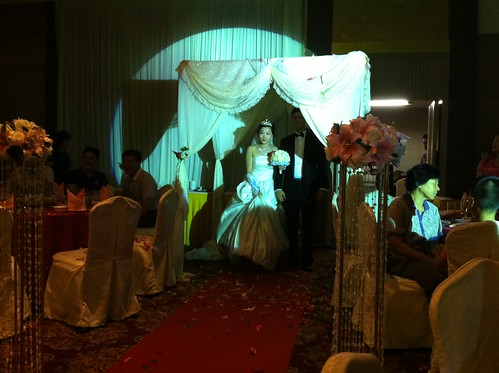
I went to a wedding in early June. It was my first wedding in China.
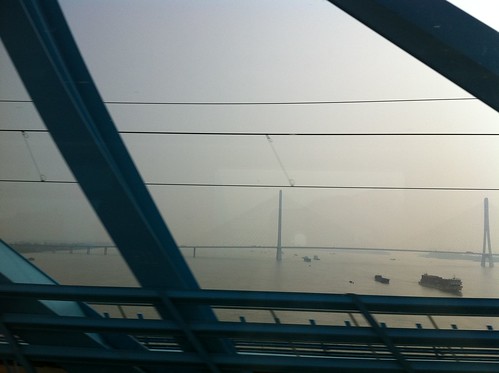
 In early July I went to Beijing for a long weekend, taking the new high-speed train there and back. The last time I went to Beijing was in 2008 and the train at that time took about 11 hours. The new train makes the trip in just over four hours.
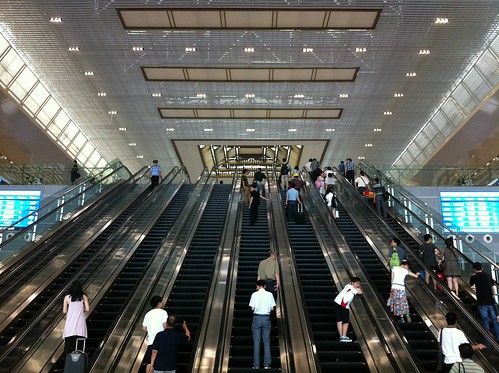
 The train took off from a new train station in Nanjing, the largest one in the country. It was finished on June 30th and I took a train on July 7th.
 There are many escalators to accomodate a large number of travelers.
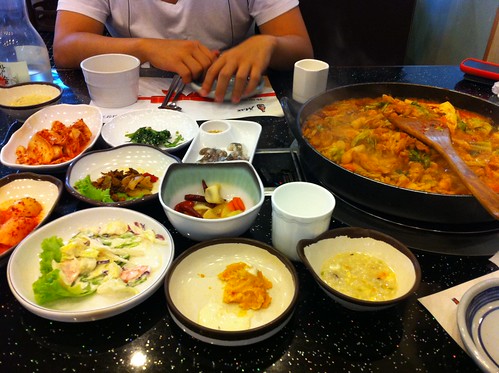
 I met up with some friends in Beijing, including one young guy who was my student in high school three years ago. He is now studying traditional Chinese medicine at a university in Beijing. Besides the things pictured on this table, I also ate an octopus that was so fresh that the tentacles were still wriggling and suctioning to the plate and to our chopsticks.
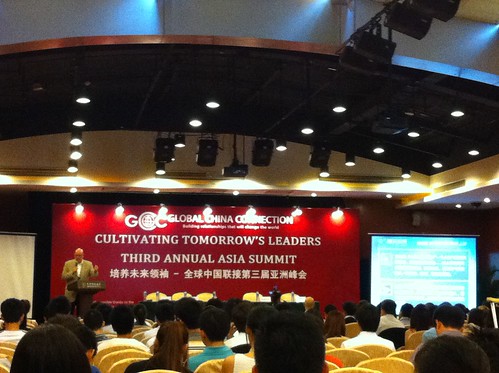
 I spent one day at a conference run by a student group, Global China Connection. I saw some well known business leaders speak, including a long-time journalist in China, James McGregor, whom I’ve admired ever since reading his book a few years ago.
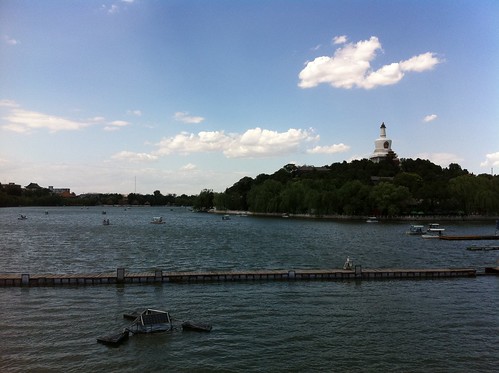
 I visited two beautiful lakes in the center of Beijing, Qianhai and Hohai.
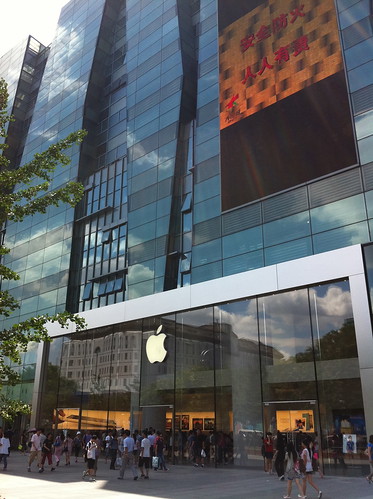
 I also made it back to my old neighborhood in the university area and walked by my old apartment. I had to check Beijing’s second Apple store, too, just to say that I’ve been to all four Apple stores in China.
 I spent a long weekend in Shanghai in early August. I helped a friend move from Nanjing to Shanghai. There was a typhoon that hit the eastern coast of China during the time we were there. It didn’t directly hit Shanghai, but we did get some strong winds and a lot of short, heavy rainfalls.
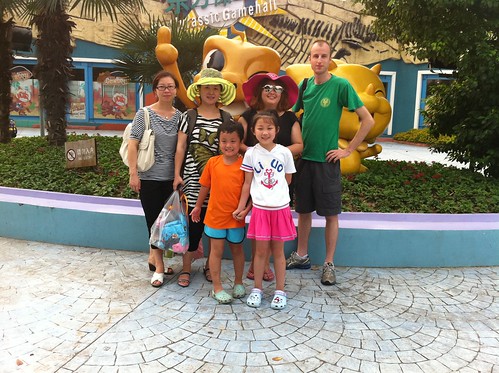
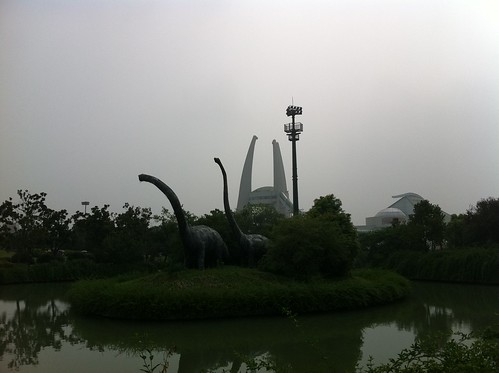
I also went to Changzhou for one day. I went with a small group of people, my roommate and three of our friends, two who have young kids, and we went to a dinosaur theme park with rides and a water park. I didn’t have a swimsuit with me so I stuck to the roller coasters and similar rides.

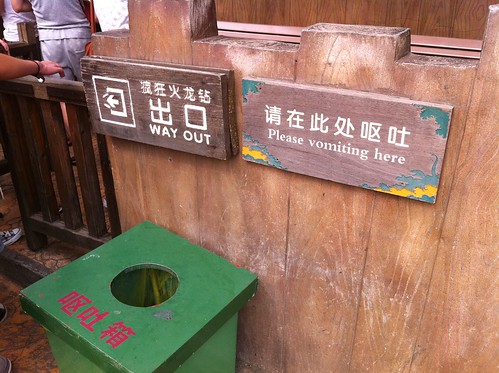
 At the exit of one ride that does a lot of swinging and spinning is this vomit bin:
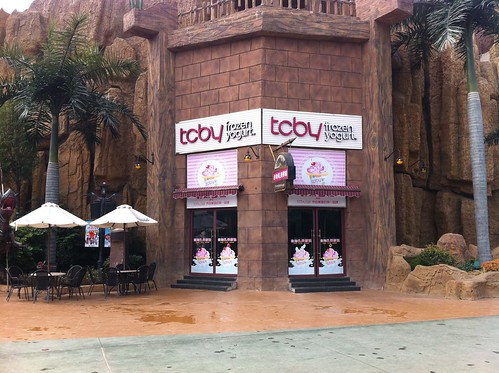
 There was a TCBY frozen yogurt stand in the park, too.
 To cap the summer, I'm off to Seoul, South Korea for five days and Japan for nine days. More travel stories to come...

Monday, August 08, 2011
iBuzzKorea offers tours of Seoul with different themes, such as dance and economic growth. I'm going to join one of their tours next week to see Samullori and talchum dance, eat Korean ssam and visit the traditional homes at Bukchon Hanok village.

How well do you know Korea? Come and meet the charms of Korea at Touch Korea! You are warmly invited!
Tuesday, November 02, 2010
National Day 2010 Trip: China Revisited
Below is a guest blog post from my dad.
Traveling in China with Sam is a whirlwind education into the growth and culture of a remarkable country. With Sam's knowledge and fluency, not to mention his zest and curiosity to see, taste and experience as much of the country as he can, we had a most enjoyable trip. I got to see Nanjing, and Sam's world of teaching and learning; Shanghai, a city that rivals any in the world for economic dynamism, and Chengdu, in Sichuan Province, which is about the size of Chicago, and is one of western China's major cities. In Nanjing, we biked past thirty foot city walls that were hundreds of years old and toured his new 14th floor apartment that was undergoing its final finishing touches as Sam signed a lease to rent with his Chinese roomate-to-be. We saw museums and universities and shopping areas that are "first-world". We rode subways that would be the envy of commuters in the USA; experienced affluence and poverty side by side in cities that are being transformed at a remarkable rate. In Shanghai, we saw a city that my mother might not even recognize 21 years after her trip there, given its growth and new affluence. In Chengdu, we laughed at China's most famous diplomats - the Panda - as they munched heartily on bamboo shoots brought to them by the wheelbarrow full, or if they are adventurous, plucked by their own paws in the bamboo forest that surrounded the breeding and research facility on Chengdu's outskirts. I marveled at Sam's mastery of the Chinese language every step of the way, and loved watching the Chinese light up as Sam began to speak to everyone we would meet on the street and they would quickly realize that this was no typical foreigner.
The US and China are remarkably similar in size, but many contrasts become apparent as soon as you step into each country. With 1.3 billion people to our 310 million, one of the first and recurrent themes is the density of humanity in much of China. If averaged over space, China has 365 people /square mile vs our 88, but I think it may be even more dramatic as China's vast western provinces are even more sparsely populated than our western US. So, the cities of China are packed with people. And when you consider how to house and feed and transport 1.3 billion every day, you can begin to fathom how remarkable China has become. Sam's new apartment, at 20 some stories, is one of thousands of new apartment buildings built every year. Shanghai didn't have a metro system until 1995, but now has 12 lines, the most metro miles of any city in the world, and had 7 million riders on a peak day last month. The metros of Nanjing and Chengdu, while smaller, are equally impressive, and more recently built than Shanghai. Sam and I rode from Nanjing to Shanghai, a distance of 284 km (176 mi) in an hour and a quarter for ~140 yuan (20 bucks) on a high speed train - another mode of transportation that has no equal to China in scope and extent. China is committed to investing in infrastructure on a scale never before seen, and at a pace probably never equaled as well. (I think the only infrastructure category we led the world in recent years was prison construction and we do quite well with new (unneeded) hospitals and sports stadiums). While construction in China definitely has a history of shortcuts and corruption (remember the shoddily constructed schools collapsing in Sichuan's hinterlands after their recent major earthquake), the grandeur of Shanghai's airport and the spotless efficiency and quality of their trains and metros means that they can build and build well when they want to. Even though China's expanding middle class is still a relatively small percentage of the population, it rivals any other in the world by fact of China's enormous population -- thus China bought more new cars than the US for the first time this past year while also creating more public transportation than any other country last year. Each city we visited had a busy street life filled with shoppers laden with packages; cars, bikes, scooters and walkers all jockeying for the right of way, and streets packed with shops of all variety, size and quality. The Chinese, viewed from street level, seem to have embraced the consumer culture full force.
While the US is described as a messy and dysfunctional democracy, Chinese Communism seemed to me to be an all-controlling, brand "China". They plan the economy and control the message; dissent is not tolerated at all (witness their treatment of the Nobel Prize winning dissident and his wife's house arrest - neither of which generated a mention in the state media while we were there). But if you can advance the economic engine, hop on the fast train with them - as the saying goes - because they move with ruthless effort. Speaking of effort, the average Chinese we encountered seemed to have it in droves, whether it was pedaling the overstuffed bicycle cart by a peasant, or the student's (and parent's) willingness to study harder and longer to advance themselves.
So, China is a land of transformation and tradition. Sam is embracing both as he has learned an incredibly difficult language well in three years and as he put it: "I've learned more in three years here than the previous four in college". The Chinese we met seemed to welcome economic opportunity and the meritocracy that does exist and is allowed in the system. They seem proud of their hard earned progress and prospects, and are willing to work and sacrifice to continue to advance their families' and their country's fortunes.
Sam fits in well with that dynamic and I was proud and honored to see a glimpse of it with him.
Sunday, October 31, 2010
South Korea
On Sunday, July 25th at 7:40 PM I finished my last English class. It was the end of a two-week stretch of summer classes at the private school where I work. During those two weeks we had students at the school every morning and afternoon during the week. Normally the classes are scheduled for weekday evenings and on weekends during the day and in the evening because the students have their regular school classes during the day Monday through Friday.
With those extra “summer camp” classes, we had lots of extra teaching hours during the week, and because we were short of teachers at the time, I had two weekends in a row of working 9 AM to 8 PM, with morning, afternoon and evening classes on Saturday and Sunday. I was exhausted and wondering what had happened to my summer break. My university classes ended about one month earlier but I had considerably less free time in July than I did in June.
It was a quick induction into the world of work, where your summer break is counted in days, not months. I had 11 days off from my nearly full-time job at the private school (30-35 hours a week) so I canceled my two part time jobs (1-5 hours a week each) to have 11 straight days off.
My short summer holiday started just after 8 PM that Sunday evening when I shared beers with a couple of coworkers in a park across the street from our school. We didn’t stay long because of the mosquitoes, so I was home by 9 to pack.
On Monday morning I woke up at 5:45 AM and was too excited to fall back asleep. I had one last bit of work to take care of. I needed to finish editing a course book for a class starting in August so I worked furiously because I knew that I wouldn’t want to have to trek to internet cafes to get work done while travelling.
At 8 AM I was done and able to leave Nanjing for the first time since going to Guangzhou and Thailand in February (other than a brief overnight trip to Changzhou in May). In late May a new subway line opened and that line has a stop just a few hundred feet from my apartment so now I am able to walk out the door, and within minutes be on a subway. The trip to the train station would take 45 minutes by bus, 25 minutes by taxi, but just 15-20 minutes by subway and costs only $0.40. The subway car was packed with Monday morning commuters, and knowing that I wasn’t going to work like everyone else made me smile.
At 9 AM I boarded a new high-speed train to Shanghai. The previous fast trains, which still run but are now less frequent, take 2.25 hours to cover the 280-kilometer journey. The new high-speed trains cruise at 300-320 km/hour, slowing down slightly when going through train station, and make the trip in 1.25 hours. It was also the first time I had taken a direct train with no stops. I love the trains and public transportation here. I can go door to door from my apartment in Nanjing to anywhere within walking distance of Shanghai’s huge subway system in less than 3 hours for around $22 (144 yuan for the train ticket, 3 yuan for the Nanjing subway, 3 to 7 yuan for the Shanghai subway). The cost of driving a car (gas and tolls) is several times the price of a train ticket and takes three to four hours. Although car and bus traffic between the two cities is still common, trains have almost completely replaced flights between the two cities.
I walked around Shanghai doing errands like changing money, booking a hostel, meeting a friend for lunch, going to a couple bookstores, ordering clothes from a tailor at the clothing market, and checking out the new Apple Store, the second one to open in Mainland China. I had dinner with a big group of Americans at an awesome Vietnamese restaurant where we had some delicious curry dishes, fried rice, spring rolls, three big bowls of this creamy slushy ice – two of peanut butter and one mango – and flan for dessert.
The second day there I went to a fake market in Pudong and had some Shanghai noodles and soup dumplings for lunch. I ran into Dan Barbato and his wife, who was due to have her baby within a week or so. It wasn’t the first time I have run into someone that I know in Shanghai, a city of nearly 20 million people, but every time it happens I’m amazed that chance encounters like that can happen when you least expect it.
I took a ferry from the east side of the river back to the west side and took the more expensive ferry with air conditioning for the first time ($0.30 versus $0.10 for the ferry without a/c). The ferry docks and the boardwalk on the west side of the river were brand new, most likely renovated for the World Expo. I met my friend Ben, who I work with in Nanjing, for dinner and we checked out the Bund at night, then went to the Jing’An temple and found a bar with outdoor seating. Ben and I first met each other in Changzhou and we met up with a British guy who we both knew in Changzhou and now lives in Shanghai.
The next morning Ben and I took a long metro ride to the airport on a new metro line extension that was finished this year, connecting the two airports on opposite sides of the city. This was also completed just in time for the World Expo.
The flight to Incheon was quick and easy, and from there we took a 45-minute bus ride to Seoul. My first impression of the country was that it was very clean and orderly, at least in comparison to China. The people were also extremely polite. On the plane and in the Incheon airport, there were a lot of travelers, the vast majority Korean, and we noticed that everyone was quiet, lines were neat orderly, and people went out of their way to let you pass by them. This was quite different from crowded places in China, which are really noisy and have few rules regarding lines and the flow of traffic. There were similar differences when we first went out and walked around. The city was surrounded by green mountains, the streets were super clean, and the traffic was eerily quiet.
After checking into our hostel, we picked an area that looked cool in a guidebook and took the subway there. We saw an area with art galleries shops lining narrow pedestrian streets. We walked along some commercial streets and ended up in a large public square where the city hall is located. People often gather in that square for public events like viewing World Cup games on large screens (http://www.boston.com/bigpicture/2010/06/halfway_in_-_2010_world_cup.html#photo8). Nearby was the train station, so we went there to buy tickets to and from Busan, a city on the southeast coast of the Korean peninsula.
We went home early that night because we were dead tired after going out in Shanghai the night before. The last thing we did before retiring for the night was walk around a huge outdoor market. There was a web of small streets lined with stalls selling cheap things. We didn’t get anything there that night but would go back there on our last day to get some gifts. That night we had some tasty and very inexpensive Korean food in an alley with lots of small restaurants. We sat at a counter and interacted a lot with the two women cooking, although we couldn’t understand each other very well. The place was nothing more than a tiny kitchen and a counter with stools. We had cold noodles, rice with mixed vegetables and chili paste, and lots of cold dishes like kimchi. When we paid the bill we just handed over a 50,000 won note because we didn’t understand what the cook said to us. When we got a lot of change back and calculated that the meal cost about $3 each, we were relieved to know that we wouldn’t go broke or hungry in Korea. There was plenty of cheap local food.
For our first full day in Korea we decided to get an early start and head to a mountain to hike. We took a good hour-long metro ride to the north side of the city. We bought some drinks and snacks at a convenience store and asked the clerk where to go to find good hiking paths. He spoke to us in Korean, motioned to the buses on the street and wrote down a name in Korean. We were able to match the name that the clerk scribbled down with a bus stop so we took a bus there only to find that it was the next subway stop. Going with what our guidebook said, we got really close to the right place on the subway, but not quite to where we needed to go.
Our guidebook also said that hiking is a popular weekend activity for Seoul’s residents and described them as the world’s best-dressed hikers. Since it was a weekday, the only hikers that day were older people and they all had nice hiking boots, quick-dry clothing, backpacks, hiking poles, hats and sunglasses. We really stood out with our casual clothes, tennis shoes and messenger bags. There were lots of outfitters and restaurants selling take-away food outside of what turned out to be a national park. We hiked up gravel paths and steep steps, past two Buddhist temples, and towards a large, exposed rock face. We had a picnic near the top with the snacks and drinks we bought that morning. Through the trees we could see parts of the city, pockets of high-rise apartments and sprawling suburbs. There was a small stream shaded by trees that was popular with picnicking hikers. In some areas it was deep enough to wade and people were floating in inner tubes or having splash fights
After that hike we took the metro to Itaewon, which is basically a foreign neighborhood populated by US soldiers and families. There were lots of American fast food chains and cheap souvenirs. I wouldn’t be surprised if locals refer to that area as Little America à la the Little Italy’s and Korea towns found in large American cities. We went to the south side of the Han River after that and walked down a hip shopping street before eating dinner at a Japanese noodle restaurant. After that we went to a busy shopping street that was full of fashionable people. There were a lot of beautiful and well dressed people.
On Friday we took a train to Busan. It was a high-speed train that took us through tunnels under a number of mountains and by many farms and small towns. The landscape in the middle of the country was very green and hilly. Within a few hours we had reached the other end of the country. Busan is a port city on the southeast coast of Korea and although it is the second largest city in the country, with a few million people, it has a very different look and feel than Seoul. The buildings are older and smaller, and the smell of the sea lingers in the air. The city is broken into smaller areas because it’s squeezed in between mountains and the rocky coast. In some neighborhoods the buildings seem to be built on top of each other because the land is so steep. The prices were also cheaper than Seoul. We stayed in a decent hotel double room for $25. When we went out searching for food we found a street near the port that was lined with restaurants. It was mid-afternoon and the majority of them were closed, so we had to imagine what the place would be like on a busy evening. There weren’t many choices at that hour, but the place we went to was really good. It was Japanese food, or at least Korean food that looked a lot like Japanese food. Japan is only a short ferry ride away from Busan so there seemed to be a lot of Japanese influence on the Korea’s east coast. I ordered cold noodles that came in two clumps on a bamboo mat, next to a bowl of cold broth. I thought the liquid in the bowl was a drink. Thin hot soup is often served with Chinese meals and it’s common to drink it straight out of the bowl, so I treated this bowl the same way and took a sip of it. The waitress came over and showed me how to eat it: put a pile of noodles in the broth, add chopped veggies and minced garlic from another bowl, stir and eat. It was humbling to be a dumb tourist again and struggle to figure out so many simple tasks like how to eat noodles. Ordering food and paying the bill was always awkward, too.
On Saturday, our one full day in Busan, we went to the ferry port and admired all the ships and the older homes that filled the steep hills around the harbor. From there we took the metro to a beach north of the city. It reminded both of us of beaches on Spain’s southern coast, such as Málaga, which we detest, so we didn’t stay at the beach very long. It was still cool to visit a beach, though, and it was only my third time going to a beach in Asia after Llama Island in Hong Kong and a few beaches on the island of Phuket.
There was a street near the train station with a traditional Chinese gate that our guidebook labeled as Busan’s Chinatown. We went there looking for Chinese people but didn’t find any. The restaurants and shops were all staffed by Koreans and there were a few businesses run by Russians; no one responded to “ni hao.” We had dinner in a place near the train station where we shared a really hearty, home-style stew with giant pork and vegetable dumplings. I think it’s the kind of things Koreans eat in the winter, not in the summer, but we weren’t very good at ordering things so we had to go with whatever we ended up with.
After dinner we went to a coffee shop. There were so many coffee shops everywhere we went that we went to one once or twice a day.
Before going to bed that night I went to an Internet café, which are also easy to find, to check my email. The internet at that café was a much better experience than using the internet in China as it was super fast and the sites blocked in China, including Facebook, Twitter, and YouTube, were all accessible. And, as I expected, a number of people in the café were playing Starcraft.
On Sunday morning we went out for coffee and a very light breakfast because we had plans for a big lunch later that day. After packing and doing some shopping, we walked around the huge indoor fish market and took our time to check out all the restaurants on the second floor. The restaurants all consisted of an open kitchen in the middle of the huge floor with a few tables on the outside near the windows. All of them had fixed multi-course menus and some of them were very busy so we could get a good idea of what they served based on what dishes were on the tables. We picked one that had open tables near a window. For $16 each we ate five courses: a half dozen cold vegetable dishes, sashimi, a cold smoked fish, a whole grilled fish and fish soup. By the time we finished it was close to 2 PM and we went straight to the train station to catch our train back to Seoul. As we left we saw people using nets to transfer live fish from a truck to buckets on the sidewalk, probably to be prepared and served for dinner that evening.
That night in Seoul we stayed in our original hostel and went out near Hong Ik University, which we had neglected to check out when we were first there. It was a very vibrant area, even in the summer, and all the young people and student-oriented shops and restaurants reminded me of State Street in Madison, Wisconsin. There was even a small bike shop that had lots of fixed-gear bikes, something that I’ve seen only once in China. We ate in that area and walked around before stopping to watch a live music performance. Some of the musicians turned out to be tap dancers, too. The energy and creativity of the young people in that area was palpable and it was cool to see live music and dancing on a warm summer night, another experience that brought me back to Madison and evenings spent hanging out on the terrace. We had some beer in the park while watching the music and tap dancing and then went to a bar for the first time.
On our last day we went to the giant COEX mall, which had a lot of the same international brands that are found in China, but one differences was the bookstores, which had more English books and far more English textbooks than the foreign language bookstores in China. We also went to a big outdoor market near an ancient city gate, Dongdaemun, where we had a cheap lunch and picked up some gifts.
We met up with two of my former classmates near a Yonsei University and had a light dinner at a student restaurant, then fruit slushy drinks at a Krispy Kreme, and then walked through Yonsei Univ. After it got dark and we couldn’t see much any more, we went to a really cool underground bar. We had a few courses of really delicious and high-end appetizers and snacks and shared pitchers of beer and small bottles of soju, the Korean grain alcohol. We played drinking games and shared some great conversation and laughter together. It was really fun to have a small reunion with Nanjing Normal University classmates in another country and to have some locals show us around. We went to several cool places that night, including one of the coolest bars that I’ve ever been to for our last stop, all of which we never would have found on our own.
South Korea was a vibrant and exciting country with an interesting mix of traditional Confucian and Buddhist culture and modern culture, with a lot of Western influences, at least on the surface. The country is definitely worth another trip.
Tuesday, June 08, 2010
Some current events in China
Nearly 10 million students are taking the “gaokao” – the university entrance exam that is the sole determinant of admission to a university today (it began yesterday and ends tomorrow). When the students take the exam, they must also choose their university and their major. They get to rank three choices of university and major and will be accepted only if they meet the minimum required score for their chosen major and university. If they fail to meet the requirement for any of their three choices, they are offered a spot at a bottom-tier school that needs to fill seats. In that case, many students choose to wait a year and take the test a second time (or go abroad if their parents have money).
http://news.xinhuanet.com/english2010/culture/2010-06/07/c_13337798.htm
Since universities are extremely competitive, it has lead to a sort of academic “arms race” where parents place a great deal of attention on their children’s education and spend more and more money on private schools and tutors. This has extended to three- and four-year-olds, who vie for spots in the best urban kindergartens. Some private kindergartens cost more than the average public university (1,000-2,000 yuan a month at many kindergartens versus 700 yuan a month for tuition and housing at Peking University, which is partly subsidized by the government).
http://abcnews.go.com/International/china-kindergarten-costs-college/story?id=10018640
Periodically stories come out about rising labor costs in China and the gradual relocation of low-cost manufacturing work to inland China and other countries in Southeast Asia. Although it’s hard to pinpoint a turning point in China’s shift from labor intensive, low-cost production of commoditized consumer goods to higher cost and more skilled-labor production of high-tech goods and services, recent labor disputes over low wages are one more important marker of this shift that has been underway in recent years.
There was an intense focus on improving labor rights in recent years, notably an expansive new labor law that went into effect in early 2008. Now the focus is turning to the wage levels of factory workers and low-skilled service workers, which have not kept up with inflation and have exacerbated the gap between rich and poor. Cities are raising minimum wages (an increase of 20% was recently announced in Beijing), workers at the largest electronics manufacturer announced two successive wage increases in the last month and workers who struck at a Honda factory in Guangdong returned to work after winning significant wage increases. The result is Americans will pay more for many everyday goods, but the working poor in China will get a fairer wage, and China’s economy will rebalance towards more domestic consumption and less export-dependent production.
http://www.nytimes.com/2010/06/08/business/global/08wages.html?src=busln
Monday, May 10, 2010
Spring 2010
In the past few weeks I’ve done a couple of notable things. For the first time, I served as a judge for an English competition. A parent of one of the young students at my school invited me to an English competition held at his company. I took along a British friend since they asked me to find a woman to serve as the second judge. We were picked up and driven to a building near the Nanjing port on the Yangtze River. The company is a subsidiary of the national oil and petrochemical company Sinopec. The main business of this Nanjing-based subsidiary is selling diesel to ships in the port, among other shipping and port services. May 4th was Youth Day, which honors people from in their teens and 20s. All of the company’s under-28 employees, about 70 in all, took an English exam and the top eight were selected for the competition. Two Chinese executives and my friend and I scored each contestant on a self-introduction and their answer to a question that we asked them, chosen from a long list of possible questions. There was supposed to be a karaoke part where we judged their singing ability in English, but thankfully the karaoke system broke down during the first song, a rendition of Hey Jude, so we only had to listen to half a song instead of eight.
There was also a long segment on business English relevant to the company’s industry. It was extremely technical and seemed to involve language that employees use when communicating with foreign ships, such as “What is the capacity of your secondary fuel tank?” “According to MARPOL standards, you must connect to our barge before extending the diesel hose...” The contestants had to translate phrases like this from English to Chinese and vice versa, examine charts of a ship’s statistics (fuel levels, temperatures, chemical content), which where just a mix of numbers and percentages, and then pick out the one value that was beyond the normally permitted bounds. There was also a segment of questions where a national flag was displayed and they had to name the country. There were a number of Asian countries, in addition to Liberia, Panama, Greece, and Cyprus. About 1/3 of the ships at the Nanjing port, which is maybe 150 miles inland but still in pretty deep water, are from countries other than China. Because of favorable laws in those last four countries, a disproportionate number of ships are registered in those nations. Overall, the contestants were really good at these technical questions and the relevant English, which didn’t make much sense to me, but were really poor at understanding and answering the questions that we gave them (What kind of books do you like to read? Who is one person who has influenced you?).
After the competition, eight older men, executives or members of the board of directors, talked to everyone about how valuable their young employees are to the company and how English is so important to everyone’s work. They went on and on for about one hour. Finally, some of the execs took the judges and the winner of the competition out for dinner at a nice hotel down the street where we had a huge feast of some local vegetable and duck dishes, three kinds of local fish, and steak, shrimp, and squid.
On April 30th I went to Changzhou and spent most of May 1st there before coming back to Nanjing for some English classes on the second. The weather was really nice and hot that weekend. Since it was a three-day weekend for the Labor Day holiday, the subway to the train station was packed (it was so crowded, stuffy, and hot that a woman next to me fainted). The train to Changzhou was also packed. Even though I bought my ticket nearly a week ahead of time, all the seats were sold out so I was given a “standing ticket.” I’ve never been relegated to a standing ticket before, but a nice family with a young girl crammed into three seats and offered their fourth seat to me. They were coming from an inland province to go see the World Expo in Shanghai and were pleased to have a chance to chat with me.
I stayed in the old place where I used to live in Changzhou. My three old roommates are all still living there, although the school has moved to a newly built campus. I had a fun night with them and then had a picnic and played Frisbee and soccer in a park the next morning. I spent the afternoon in downtown Changzhou, which wasn’t very pleasant because it was full of people and loud construction. I went to two large parks but could never find a quiet spot and was never left alone. When many people are off of work and school all at the same time, the public spaces in China’s cities become overwhelmed with people. National holidays also coincide with shopping sales, which makes the city crowds even worse.
Lately I have found some time to get out and do some serious running again. It feels good to have really warm weather and be active again. There are some minor running events in Nanjing and I may join one of the big marathons in the fall with a friend and do a half marathon. Last weekend Nanjing Normal University had a sports meet for graduate students. I missed the one for undergraduates last year because of work, but this time I rearranged my Saturday English classes and joined the sports meet for the opening ceremony and competed in two events. The opening ceremony was very official and highly coordinated, like most events in China, whether big or small. One by one, a group of 20-30 students representing a different college or department and dressed in uniforms and carrying banners marched around the track and paused at the main stands to do a brief performance. My classmates were told to wear something representative of our home country. I was told to wear a suit but choose to wear a T-shirt, running shoes, and shorts instead. Only some of the girls in my class from different Asian countries wore traditional outfits. I thought my Nike shorts and Asics running shoes were typical enough for American dress. I did the long jump and my best jump was 4.8 meters, which was okay (around 10th place) but turned out to be about a meter short of the longest jump of the day. My other event was the long distance run, which was 1500 meters. A few days before all of the runners had to go to the university clinic to have our heart (an EKG) and blood pressure checked. I’ve encountered so many ridiculous things in China that nothing really surprises me anymore. It was hard not to laugh however, when a nurse asked me if I thought I could run 1.5 kilometers and needed to do this health check just to make sure. I just said “yes,” and didn’t bring up the fact that I’ve run a marathon – 42 kilometers – without a problem. I was in the last heat, and there was one guy with the look of a fast and extremely fit runner, who also turned out to be from the sports and kinesiology department, and he blew us all away. I came in third out of 15 runners. There was no final heat and I’m not sure where my time stood among all the runners. It was a fun time and I hope to get a lot more running in before the rainy season starts. In June it’s often in the 90s and it rains almost every day. The weather in May is quite ideal, however, and it has been that way so far.
There are some recent pictures here: http://www.flickr.com/photos/59071041@N00/
A piece about the English competition: http://www.zshcr.com.cn/news_view.asp?id=2523
Tuesday, May 04, 2010
25
I'm now 25 years old, which is a milestone that warrants some reflection as I'm no longer in my early 20s, I'm much closer to 30 than my teenage years, and have already lived a full quarter of a century.
This semester I've been taking graduate level courses in Chinese and education. My teachers last semester suggested that I apply for a scholarship and in the middle of the school year it was not possible to apply for the undergraduate Chinese language program. I had completed year two and was going to go on to year three of the language classes. There were ten spots available for spring enrollment in a relatively new program - a master's in teaching Chinese as a foreign language. The classes are more challenging than the language classes I was in before because they're lectures and involve a some independent reading, writing, presentations and projects. My classmates all have very good levels of Chinese so it's pushing me to work harder and keep up. As a teacher, I also find the classes quite useful because our courses cover education related topics such as pedagogy, second language acquisition, and cross-cultural communication. There are no universities that I know of in China that offer an MA in TESOL (teaching English to speakers of other languages), so an MA in teaching Chinese to speakers of other languages is an adequate substitute, not to mention that everything is conducted in Chinese and with a scholarship it's free and includes a small monthly stipend on the side. My classmates are pretty diverse, coming Eastern Europe (Poland, Russia and the Ukraine), South Asia (Sri Lanka), central Asia (Mongolia, Kyrgyzstan) and Southeast Asia (Vietnam, Thailand, Indonesia, and Malaysia). There is one other American and we are the only students who's home country is in the western hemisphere and we're the only native English speakers.
In recent weeks I've been busy with my old job teaching little kids, though I've cut down my hours and now have started tutoring high school students at Nanjing Normal University through a training center that helps prepare students to study abroad. I will become more involved there this summer when I have more time and when summer classes will be organized for SAT and TOEFL exam preparation. There may also be AP classes depending on what AP subjects students plan to take the exams for.
We had midterm exams in late April and now I'm working on a project and two papers due at the end of the semester in June.
It's really warm and so far pretty dry. It is not uncommon to have temperatures in the 80s during the day and in the 70s at night now. June is the wettest month of the year, when it rains nearly every evening, so I'm waiting for the regular rainstorms to come soon.
Subscribe to:
Posts (Atom)