My roommate's sudden diagnosis of tuberculosis in September was an eye-opening experience about a disease that I had thought was only found in history books or in the poorest developing countries. It is still a common killer around the world while its highly contagious nature and drug-resistant strains are a ticking time bomb.
Nick Kristof wrote an insightful essay in yesterday's New York Times on the disease. His previous piece is also a must-read on another overlooked public health problem - iodine deficiency.
Tuesday, December 09, 2008


Friday, December 05, 2008
Marathon
The marathon was marked in kilometers (42.195 total) so I’ll break it down into five kilometer sections and give a brief recap.
Kilometers 0-5: I shuffle along in a dense pack of runners, the sidewalks and pedestrian bridges are also packed with onlookers. The streets are fairly narrow and the sun is still low so we are in the shade and it's pretty cold. Kilometers 6-10: I start to break a sweat and get more room to open up my stride. We run under a raised six-lane road for a while so there is still no need for sunglasses. Every once in a while there is a group of older Chinese women in colorful outfits banging drums and symbols, chanting “jia you… yun dong yuan… jia you…” (let’s go, runners, let’s go…) Kilometers 11-15: we run down long stretches of road heading south, the runners thin out and it starts to feel more like a long-distance race. Kilometers 16-20: the longest race I’ve ever run is 15k, so I’m in new territory by now, and I start to feel a little tight and sore in my butt and calves. Kilometers 21-25: I cross the half way point around 1:50 hours, chat with several runners in my vicinity - a Canadian living in Vietnam, a Korean living in China, and a local Chinese guy.
Kilometers 26-30: I start to feel some pain in my knees from the pounding and my legs are stiffer and harder to move. I close my eyes halfway and settle in behind other runners, just watching their feet and following behind, not thinking about much. We go up and over some six-lane highway overpasses which are the only “hills” on the route. The runners get two full lanes and a long line of cars and trucks are squeezed into one lane and are backed up for long stretches. I see an exasperated man in a suit get out of a taxi, pay, and start walking. Others are sitting in their stalled cars with the doors open, smoking and watching us jog by. Kilometers 31-35: I thought I’d have plenty of time to think during the race, to let my mind run through all the things I’ve done in the past year and a half, think about next year, about my family, etc. but my brain partially shuts down and all I can concentrate on is the next kilometer marker. I strain my neck to look for the big white signs with large red numbers that mark each kilometer. Anything red and white grabs my attention. I don’t do much thinking other than repeating to myself over and over “Where’s 33… just find 33… 33…” There are few people along this section of the run, other than a few bored volunteers with water and first aid kits. We run by lots of factories and make frequent turns, zigzagging north towards the finish area outside a sports stadium.
Kilometers 36-40: Just over four hours into the race and still miles from the finish, I’m walking on and off and I resign myself to the fact that I won’t finish in under four hours. My shirt is hardly even damp from sweat, my back and neck are fine, despite my worries that I’d get a lot of back pain from bad posture. In fact, my entire upper body is feeling great but from the waist down I’m in intense pain. I can barely move my legs. I get a spray of icy-hot from a volunteer on my legs, scarf down a banana, sip a sports drink, all to no avail. I simply can’t move my legs. I shuffle and walk a lot while rubbing down my thighs and butt with my hands, trying to get some flexibility and movement out of my legs. It’s a strange feeling.
The kilometer 40 marker gives me a boost of energy and I’m able to shuffle-jog the last 2 kilometers, cross the finish line (all that was going through my head was “finish… finish… finish”). I immediately head into a large public bathroom in the sports complex, which is full of sweaty half naked men bathing in the sinks and I almost vomit from the stench. I urinate for the first time since the start but never really felt dehydrated due to sweating so little. I get a small medal, a certificate with my time, and a bag of little goodies, including a small bottle of Kikkoman soy sauce.
I had little trouble walking later that day and had sore legs for the two following days. The quick recovery made me realize that I could have and should have pushed myself harder at the end. Looking back, it was more my mind telling me that my legs wouldn’t move if I only mustered more will power. I’ve got to do another one next year.
Kilometers 0-5: I shuffle along in a dense pack of runners, the sidewalks and pedestrian bridges are also packed with onlookers. The streets are fairly narrow and the sun is still low so we are in the shade and it's pretty cold. Kilometers 6-10: I start to break a sweat and get more room to open up my stride. We run under a raised six-lane road for a while so there is still no need for sunglasses. Every once in a while there is a group of older Chinese women in colorful outfits banging drums and symbols, chanting “jia you… yun dong yuan… jia you…” (let’s go, runners, let’s go…) Kilometers 11-15: we run down long stretches of road heading south, the runners thin out and it starts to feel more like a long-distance race. Kilometers 16-20: the longest race I’ve ever run is 15k, so I’m in new territory by now, and I start to feel a little tight and sore in my butt and calves. Kilometers 21-25: I cross the half way point around 1:50 hours, chat with several runners in my vicinity - a Canadian living in Vietnam, a Korean living in China, and a local Chinese guy.
Kilometers 26-30: I start to feel some pain in my knees from the pounding and my legs are stiffer and harder to move. I close my eyes halfway and settle in behind other runners, just watching their feet and following behind, not thinking about much. We go up and over some six-lane highway overpasses which are the only “hills” on the route. The runners get two full lanes and a long line of cars and trucks are squeezed into one lane and are backed up for long stretches. I see an exasperated man in a suit get out of a taxi, pay, and start walking. Others are sitting in their stalled cars with the doors open, smoking and watching us jog by. Kilometers 31-35: I thought I’d have plenty of time to think during the race, to let my mind run through all the things I’ve done in the past year and a half, think about next year, about my family, etc. but my brain partially shuts down and all I can concentrate on is the next kilometer marker. I strain my neck to look for the big white signs with large red numbers that mark each kilometer. Anything red and white grabs my attention. I don’t do much thinking other than repeating to myself over and over “Where’s 33… just find 33… 33…” There are few people along this section of the run, other than a few bored volunteers with water and first aid kits. We run by lots of factories and make frequent turns, zigzagging north towards the finish area outside a sports stadium.
Kilometers 36-40: Just over four hours into the race and still miles from the finish, I’m walking on and off and I resign myself to the fact that I won’t finish in under four hours. My shirt is hardly even damp from sweat, my back and neck are fine, despite my worries that I’d get a lot of back pain from bad posture. In fact, my entire upper body is feeling great but from the waist down I’m in intense pain. I can barely move my legs. I get a spray of icy-hot from a volunteer on my legs, scarf down a banana, sip a sports drink, all to no avail. I simply can’t move my legs. I shuffle and walk a lot while rubbing down my thighs and butt with my hands, trying to get some flexibility and movement out of my legs. It’s a strange feeling.
The kilometer 40 marker gives me a boost of energy and I’m able to shuffle-jog the last 2 kilometers, cross the finish line (all that was going through my head was “finish… finish… finish”). I immediately head into a large public bathroom in the sports complex, which is full of sweaty half naked men bathing in the sinks and I almost vomit from the stench. I urinate for the first time since the start but never really felt dehydrated due to sweating so little. I get a small medal, a certificate with my time, and a bag of little goodies, including a small bottle of Kikkoman soy sauce.
I had little trouble walking later that day and had sore legs for the two following days. The quick recovery made me realize that I could have and should have pushed myself harder at the end. Looking back, it was more my mind telling me that my legs wouldn’t move if I only mustered more will power. I’ve got to do another one next year.
Wednesday, December 03, 2008
Over consumption
You ever wonder how the United States could have a negative personal savings rate? The reason may be that whatever little we do save throughout the year we blow on holiday shopping in November and December.
In an article about shopping during last week's Black Friday, one shopper remarked that “in the past she would ‘spend thousands of dollars on Black Friday’ - even withdrawing money from her retirement account.”
Another shopper on Black Friday justified her shopping spree on the recession. "The fact that the economy is down has actually led me to spend a little more this holiday season, because there are so many good sales out there today," said Owolagi, a nurse, who spent more than $1,000 at three retailers by 8:30 a.m.
Another explained her credit card purchases, "I am paying a lot with credit cards, and I'm hoping the banks go out of business and I won't have to pay them back.”
That was not from “The Onion” and those are genuine comments from real people, despite sounding like a outrageous parody of lazy, debt-ridden Americans. Some people are hopeless.
And we overeat, too. Several interesting studies have shown how we underestimate the calories of diet foods, trans-fat free foods, and meals from restaurants that are marketed as health-concious places with more diet-friendly fare. The result of this miscalcuation is that we eat more of supposedly healthier options and in the end consume even more calories.
In an article about shopping during last week's Black Friday, one shopper remarked that “in the past she would ‘spend thousands of dollars on Black Friday’ - even withdrawing money from her retirement account.”
Another shopper on Black Friday justified her shopping spree on the recession. "The fact that the economy is down has actually led me to spend a little more this holiday season, because there are so many good sales out there today," said Owolagi, a nurse, who spent more than $1,000 at three retailers by 8:30 a.m.
Another explained her credit card purchases, "I am paying a lot with credit cards, and I'm hoping the banks go out of business and I won't have to pay them back.”
That was not from “The Onion” and those are genuine comments from real people, despite sounding like a outrageous parody of lazy, debt-ridden Americans. Some people are hopeless.
And we overeat, too. Several interesting studies have shown how we underestimate the calories of diet foods, trans-fat free foods, and meals from restaurants that are marketed as health-concious places with more diet-friendly fare. The result of this miscalcuation is that we eat more of supposedly healthier options and in the end consume even more calories.
Thursday, November 27, 2008
Two ways of looking at carbon emissions and other data
While clicking around on Wikipedia recently, I came across two maps on global CO2 emissions.

Total CO2 emissions (the developed countries and the rapidly developing economies of Russia, India, and China are the biggest emitters).
CO2 emissions per capita (the U.S., Australia, and the Persian Gulf states are the dirtiest).

This reminded me of a Chinese news article (English translation) that compared the economic consumption levels of the United States and China, adjusted to the population size. The conclusion: “the consumption of China’s 1.3 billion people is only equivalent to a population of 43 million Americans.”
This number is reached by comparing consumption levels, in US dollars, per person in the two countries.
“In 2006, US per capita income was $36,000 and total consumption was nine trillion dollars. The US has a population of 300 million so per capita consumption was $30,000. In 2006, China’s per capita income was $2,000 and its consumption rate was 51%. Thus, per capita consumption was $1,000 or 1/30th of the US per capita consumption. If you divide 1.3 billion by 30, the consumption of China’s 1.3 billion people is only equivalent to a population of 43 million Americans.”
It’s worth noting that consumption levels measured in dollars are considerably skewed by purchasing power and exchange rates. One dollar buys 6.8 yuan at official exchange rates, yet the yuan is undervalued by 15-20% due to government capital controls, and a dollar buys a lot more (2-4 times as much for most goods and services) in China than in the United States because of the lower cost of living.
It all goes to show how data can be selectively chosen and tinkered with to produce very different conclusions. It’s also a reminder that absolute size is not everything, instead the relative amount (or per capita value) is more relevant, especially when comparing among countries. China is the world’s largest source of C02 emissions, yet the average person consumes 1/30th of the average American’s consumption level. The United States is 5% of the world’s population, yet we consume 25% of the world’s energy.

Total CO2 emissions (the developed countries and the rapidly developing economies of Russia, India, and China are the biggest emitters).
CO2 emissions per capita (the U.S., Australia, and the Persian Gulf states are the dirtiest).

This reminded me of a Chinese news article (English translation) that compared the economic consumption levels of the United States and China, adjusted to the population size. The conclusion: “the consumption of China’s 1.3 billion people is only equivalent to a population of 43 million Americans.”
This number is reached by comparing consumption levels, in US dollars, per person in the two countries.
“In 2006, US per capita income was $36,000 and total consumption was nine trillion dollars. The US has a population of 300 million so per capita consumption was $30,000. In 2006, China’s per capita income was $2,000 and its consumption rate was 51%. Thus, per capita consumption was $1,000 or 1/30th of the US per capita consumption. If you divide 1.3 billion by 30, the consumption of China’s 1.3 billion people is only equivalent to a population of 43 million Americans.”
It’s worth noting that consumption levels measured in dollars are considerably skewed by purchasing power and exchange rates. One dollar buys 6.8 yuan at official exchange rates, yet the yuan is undervalued by 15-20% due to government capital controls, and a dollar buys a lot more (2-4 times as much for most goods and services) in China than in the United States because of the lower cost of living.
It all goes to show how data can be selectively chosen and tinkered with to produce very different conclusions. It’s also a reminder that absolute size is not everything, instead the relative amount (or per capita value) is more relevant, especially when comparing among countries. China is the world’s largest source of C02 emissions, yet the average person consumes 1/30th of the average American’s consumption level. The United States is 5% of the world’s population, yet we consume 25% of the world’s energy.
Saturday, November 22, 2008
The Yangzte River and other news
I’ve lived within 10-15 miles of the Yangtze River for about 13 of the past 15 months but I had never laid eyes on it until today. I had heard that it’s possible to bike there and back so I tried it out, wearing bike shorts and long underwear under my clothing, and reached the river in just over an hour. It was an interesting ride, sharing a quiet four lane road with trucks, buses, a few cars, many motorcycles and electric bikes, a few tricycles hauling trash, and some pedestrians with luggage, either waiting to be picked up or looking for a ride. On either side of the road were factories, abandoned fields, and run down concrete homes and warehouses.
I expected it to take longer than it did to reach the river, so I wasn’t sure what to make of all the cranes, empty paved lots, and piles of sand and coal. It certainly started to look like a port and there were signs pointing to the Changzhou port and a harbor. I turned down one of the smaller roads headings towards cranes and biked until it ran into a long rolling hill with a narrow road on top. I carried my bike up the hill hoping there was a river on the other side and indeed there it was, the longest river in Asia.
It was only about 100 yards wide and there was a bridge across it, so even though it was much bigger than any canal or river I’ve seen before in China, I thought it was quite the Yangtze River. Once I got on the bridge, I realized that it went to an island on the south side of the river and most of the river was just to the north. From the highest point in the middle of the bridge, I was able to see pretty far and watch two barges go by directly underneath me. There was a port full of cargo containers and cranes and an export customs office on the island and lots of huge ships. I got a lot of strange looks by workers near the river and on the roads there and back people on motorcycles and sometimes an entire bus full of people would turn their heads around stare at me. There must almost never be cyclists out for a casual ride on those roads.
[UPDATE] Some pictures are now online.
The economic situation in China has some parallels to the United States, slowing growth and sharp falls in real estate values and inflation and the government announced a stimulus package of over $500 billion. As in the U.S., there may be an additional bailout for Chinese car companies. In other ways it’s entirely different – GDP growth may slow to 5 or 6% and cities are still growing at an astounding rate
And the largest foreign holder of American debt is now .
A couple other things of note, an oft-forgotten part of China, the expansive northwestern province of Xinjiang, has an interesting debate over ethnic and cultural histories, sparked by several mummies preserved for thousands of years in the dry desert climate.
Kimchi, which is a Korean dish of vegetables pickled with chilies and garlic, is something I eat several times a week at school and on occasional visits to Korean restaurants. In Seoul this week, 2,200 people helped make 143 tons of the stuff. Kimchi has a strong smell so I wonder if the whole city stunk, so I hope it wasn’t a hot day and it was all eaten or refrigerated.
Finally, the Shanghai Marathon is next Sunday, November 30. I signed up and plan to run the full marathon.
I expected it to take longer than it did to reach the river, so I wasn’t sure what to make of all the cranes, empty paved lots, and piles of sand and coal. It certainly started to look like a port and there were signs pointing to the Changzhou port and a harbor. I turned down one of the smaller roads headings towards cranes and biked until it ran into a long rolling hill with a narrow road on top. I carried my bike up the hill hoping there was a river on the other side and indeed there it was, the longest river in Asia.
It was only about 100 yards wide and there was a bridge across it, so even though it was much bigger than any canal or river I’ve seen before in China, I thought it was quite the Yangtze River. Once I got on the bridge, I realized that it went to an island on the south side of the river and most of the river was just to the north. From the highest point in the middle of the bridge, I was able to see pretty far and watch two barges go by directly underneath me. There was a port full of cargo containers and cranes and an export customs office on the island and lots of huge ships. I got a lot of strange looks by workers near the river and on the roads there and back people on motorcycles and sometimes an entire bus full of people would turn their heads around stare at me. There must almost never be cyclists out for a casual ride on those roads.
[UPDATE] Some pictures are now online.
The economic situation in China has some parallels to the United States, slowing growth and sharp falls in real estate values and inflation and the government announced a stimulus package of over $500 billion. As in the U.S., there may be an additional bailout for Chinese car companies. In other ways it’s entirely different – GDP growth may slow to 5 or 6% and cities are still growing at an astounding rate
And the largest foreign holder of American debt is now .
A couple other things of note, an oft-forgotten part of China, the expansive northwestern province of Xinjiang, has an interesting debate over ethnic and cultural histories, sparked by several mummies preserved for thousands of years in the dry desert climate.
Kimchi, which is a Korean dish of vegetables pickled with chilies and garlic, is something I eat several times a week at school and on occasional visits to Korean restaurants. In Seoul this week, 2,200 people helped make 143 tons of the stuff. Kimchi has a strong smell so I wonder if the whole city stunk, so I hope it wasn’t a hot day and it was all eaten or refrigerated.
Finally, the Shanghai Marathon is next Sunday, November 30. I signed up and plan to run the full marathon.
Wednesday, November 05, 2008


Tuesday, November 04, 2008
The Presidential election
A sense of doubt always hangs in the air the night before an election, even if there is a big spread in the latest polls, because really all that matters is the vote tally on election day. It’s a little odd to be overseas during such an important election, but I am glad that it’s almost over (I remember talking about it with students in Spain nearly three years ago as rumors emerged about who was going to run), and I’m happy to be removed from all the day-to-day advertisements and gossip. It’s allowed me to take a more critical view and a wider perspective on the race.
Every Chinese paper today had a long article on the election and will certainly have extensive coverage of the results in Thursday’s edition. You can read a collection of views on the election from people around the world in The Guardian.
Everyone is connected to the United States and every nation is affected by our policies, but it’s notable that many in Asia feel strongly that America’s influence is declining as others grow in wealth and power.
In one young Chinese man’s view, "America is going down, while China is rising up." Another commented that "A lot of young people still think America is our enemy. They're quite happy with the sub-prime crisis - they think this is China's chance."
The sentiment in Russia is similar: "We don't beg from the west any more and Washington can't order us around like it did in the 1990s."
Kishore Mahbubani, a Singaporean former diplomat and now dean of a public policy school, is one of my favorite commentators on current events and he recently described how Asia is handling the and coming out ahead. He’s written several books on how Asia and the West differ, and how the West will no longer dominate world affairs. The subprime crisis and the financial bankruptcies in the Europe and America are one such example of the reversal of roles between the two.
If I have no trouble sleeping tonight I’ll be up in time to see the first results from the East Coast come in as polls close and hopefully see the final results before my first class at 1:25 pm (my morning classes were cancelled for exams).
Every Chinese paper today had a long article on the election and will certainly have extensive coverage of the results in Thursday’s edition. You can read a collection of views on the election from people around the world in The Guardian.
Everyone is connected to the United States and every nation is affected by our policies, but it’s notable that many in Asia feel strongly that America’s influence is declining as others grow in wealth and power.
In one young Chinese man’s view, "America is going down, while China is rising up." Another commented that "A lot of young people still think America is our enemy. They're quite happy with the sub-prime crisis - they think this is China's chance."
The sentiment in Russia is similar: "We don't beg from the west any more and Washington can't order us around like it did in the 1990s."
Kishore Mahbubani, a Singaporean former diplomat and now dean of a public policy school, is one of my favorite commentators on current events and he recently described how Asia is handling the and coming out ahead. He’s written several books on how Asia and the West differ, and how the West will no longer dominate world affairs. The subprime crisis and the financial bankruptcies in the Europe and America are one such example of the reversal of roles between the two.
If I have no trouble sleeping tonight I’ll be up in time to see the first results from the East Coast come in as polls close and hopefully see the final results before my first class at 1:25 pm (my morning classes were cancelled for exams).
Sunday, October 26, 2008
Shanghai and Suzhou with Andy
Last weekend a couple things were going on in Shanghai. Andy was in town and had the weekend off, so I meet him after he got off work on Friday night and had dinner together at a Japanese restaurant. He was shocked when I first opened my mouth to order in Chinese (though not very good Chinese), because the last time he had seen me was seven months ago. It’s barely noticeable to me because its slow and incremental, but I’ve improved a lot in that time and now can get by pretty well interacting with people in Chinese.
On Saturday we saw a lot of the city and did quite a bit of shopping. We were on the streets much earlier than when most stores open, so we spent the early morning walking around new and old parts of central Shanghai, including the new skyscrapers around People’s Square, the old two-story stone houses in Xintiandi, and the run-down, local neighborhoods around the touristy Old Quarter and Yu Yuan Garden. We saw the same little shops and businesses – noodle restaurants, barber shops, bike repair shops, tobacco vendors – over and over again. When we came upon a street full of fresh produce, seafood, and meat, the first thing sight we saw was a butcher chopping a chicken’s head off and draining the blood into a bucket before tossing it into a pot of boiling water. It’s very different on the streets of China, all normal to me now, but it was fun to see Andy’s culture shock and his interest in every little aspect of daily life.
Inside the Old Quarter, we waited in line for over an hour to buy a couple servings of xiao long bao, the Shanghai specialty of soup dumplings. The long wait was livened up by watching all of the tour groups shuffle around in big herds, and we were both interviewed by a marketing researcher, and then pestered with questions by an eager young Chinese guy. I get lots of attention, but even more when I’m with other foreigners. Andy and I seemed to be pretty popular.
When we started to make our way to an antiques market, the first taxi we saw was a three-wheeled motorcycle with a little bench in the back. It didn’t take long to realize we were both thinking, “sweet, let’s do it!” so we immediately hired the driver to take us to the antiques market. We later took some pictures by the river and then went to shopping in a big store… I can’t say the name of the place because it will give away the contents of many Christmas gifts.
That evening I met my roommate and about 18 of our friends for dinner. He only recently was able to check out of the Chinese hospital where he had been receiving treatment for his TB and get permission to return to his home country. (I got another TB test that weekend, by the way, and am still TB free!) We were there until the place closed and we all said our goodbyes before he flew home the next day.
On Sunday Andy and I took a day trip to Suzhou, a medium-sized city (5 million to Shanghai’s 18 million) roughly half an hour away by train to the southwest. We took another pseudo-taxi from the train station. This time it was an old guy with a bicycle rickshaw. It was a rusty old single gear bicycle, and with the two of us on the rear bench we were going along at about walking speed, until we reached a bridge and the poor guy had to get off and pull us up and over the bridge.
Our first stop was a silk museum, were we saw lots of old silk clothing and looms and a large, flat basket of leaves where hundreds of pasty white little silk worms were munching away. They were funny little things with six little feet near their heads that they use to hold a leaf, and then they nibble from side-to-side, making little half circles in the leaf. Like all worms, they have several hearts (or simple artery pumps, rather) that you could see rhythmically pulsing under their pale skin. It was a fascinating site to see this ugly little worms turning green leaves into beautiful silk (and feces).
Our next taxi ride was a regular taxi, probably an old VW, and the driver dropped us off on a street with plenty of good restaurants. We vacillated between a few before settling on one serving food from the southern Hunan province. Little did we know what we would discover on the menu. In the picture-filled English menu there was lots of good pictures and descriptions of dishes for adventurous carnivores, such as duck gizzards, “duck cooked in soil sauce,” hotpot with pig intestines, and turtles, both large and small (baby turtles). On the Chinese menu only there were two hotpots with dog meat. Finally, there was a simple vegetable dish with the most shocking name imaginable, “Fuckness w/ eggplant.”
It was hard to control our laughter (to the point of tears in our eyes, it was a good laugh), we attracted a few stares, and then were disappointed to learn that they were out of the fuckness with eggplant and that we could not keep the menu, despite Andy’s steady pleas.
We browsed some silk shops, a book store, pet stores, an antiques store, and saw a few canals and lots of rundown housing, and then got lost after walking for miles around the city. Minutes after Andy said in exasperation, “My dogs are barking, I don’t think I can walk much longer,” we came upon a foot massage parlor. Another spontaneous, “what the hell - let’s do it!” decision and we both found ourselves reclined in armchairs with our shoes off about to get our first ever foot massage. Two sister, Xiao Lei and Da Lei, spent 45 minutes soaking, moisturizing, kneading, and massaging our calves and feet. Most of the time we were gritting our teeth from the pain (it sometimes hurt a heck of a lot) or laughing from the ticklishness of the whole ordeal. And the two sisters were hilarious. They rarely get any foreign customers, and only from nearby countries such as Japan and Russia. Most of the time we were able to communicate in Chinese, and even when we couldn’t, they always understood our yelps of pain or our laughter from the ticklish sensations (or from the whole absurdity of a getting a foot massage in this little place).
Those are just some of fun stories and adventures from the weekend. I took some pictures on my iPhone, so the quality isn’t so great.
Lastly, the Milwaukee Bucks played an exhibition game in China the week before. And who knew their 2008 draft pick, Joe Alexander, spent part of his childhood in China and speaks Mandarin?
On Saturday we saw a lot of the city and did quite a bit of shopping. We were on the streets much earlier than when most stores open, so we spent the early morning walking around new and old parts of central Shanghai, including the new skyscrapers around People’s Square, the old two-story stone houses in Xintiandi, and the run-down, local neighborhoods around the touristy Old Quarter and Yu Yuan Garden. We saw the same little shops and businesses – noodle restaurants, barber shops, bike repair shops, tobacco vendors – over and over again. When we came upon a street full of fresh produce, seafood, and meat, the first thing sight we saw was a butcher chopping a chicken’s head off and draining the blood into a bucket before tossing it into a pot of boiling water. It’s very different on the streets of China, all normal to me now, but it was fun to see Andy’s culture shock and his interest in every little aspect of daily life.
Inside the Old Quarter, we waited in line for over an hour to buy a couple servings of xiao long bao, the Shanghai specialty of soup dumplings. The long wait was livened up by watching all of the tour groups shuffle around in big herds, and we were both interviewed by a marketing researcher, and then pestered with questions by an eager young Chinese guy. I get lots of attention, but even more when I’m with other foreigners. Andy and I seemed to be pretty popular.
When we started to make our way to an antiques market, the first taxi we saw was a three-wheeled motorcycle with a little bench in the back. It didn’t take long to realize we were both thinking, “sweet, let’s do it!” so we immediately hired the driver to take us to the antiques market. We later took some pictures by the river and then went to shopping in a big store… I can’t say the name of the place because it will give away the contents of many Christmas gifts.
That evening I met my roommate and about 18 of our friends for dinner. He only recently was able to check out of the Chinese hospital where he had been receiving treatment for his TB and get permission to return to his home country. (I got another TB test that weekend, by the way, and am still TB free!) We were there until the place closed and we all said our goodbyes before he flew home the next day.
On Sunday Andy and I took a day trip to Suzhou, a medium-sized city (5 million to Shanghai’s 18 million) roughly half an hour away by train to the southwest. We took another pseudo-taxi from the train station. This time it was an old guy with a bicycle rickshaw. It was a rusty old single gear bicycle, and with the two of us on the rear bench we were going along at about walking speed, until we reached a bridge and the poor guy had to get off and pull us up and over the bridge.
Our first stop was a silk museum, were we saw lots of old silk clothing and looms and a large, flat basket of leaves where hundreds of pasty white little silk worms were munching away. They were funny little things with six little feet near their heads that they use to hold a leaf, and then they nibble from side-to-side, making little half circles in the leaf. Like all worms, they have several hearts (or simple artery pumps, rather) that you could see rhythmically pulsing under their pale skin. It was a fascinating site to see this ugly little worms turning green leaves into beautiful silk (and feces).
Our next taxi ride was a regular taxi, probably an old VW, and the driver dropped us off on a street with plenty of good restaurants. We vacillated between a few before settling on one serving food from the southern Hunan province. Little did we know what we would discover on the menu. In the picture-filled English menu there was lots of good pictures and descriptions of dishes for adventurous carnivores, such as duck gizzards, “duck cooked in soil sauce,” hotpot with pig intestines, and turtles, both large and small (baby turtles). On the Chinese menu only there were two hotpots with dog meat. Finally, there was a simple vegetable dish with the most shocking name imaginable, “Fuckness w/ eggplant.”
It was hard to control our laughter (to the point of tears in our eyes, it was a good laugh), we attracted a few stares, and then were disappointed to learn that they were out of the fuckness with eggplant and that we could not keep the menu, despite Andy’s steady pleas.
We browsed some silk shops, a book store, pet stores, an antiques store, and saw a few canals and lots of rundown housing, and then got lost after walking for miles around the city. Minutes after Andy said in exasperation, “My dogs are barking, I don’t think I can walk much longer,” we came upon a foot massage parlor. Another spontaneous, “what the hell - let’s do it!” decision and we both found ourselves reclined in armchairs with our shoes off about to get our first ever foot massage. Two sister, Xiao Lei and Da Lei, spent 45 minutes soaking, moisturizing, kneading, and massaging our calves and feet. Most of the time we were gritting our teeth from the pain (it sometimes hurt a heck of a lot) or laughing from the ticklishness of the whole ordeal. And the two sisters were hilarious. They rarely get any foreign customers, and only from nearby countries such as Japan and Russia. Most of the time we were able to communicate in Chinese, and even when we couldn’t, they always understood our yelps of pain or our laughter from the ticklish sensations (or from the whole absurdity of a getting a foot massage in this little place).
Those are just some of fun stories and adventures from the weekend. I took some pictures on my iPhone, so the quality isn’t so great.
Lastly, the Milwaukee Bucks played an exhibition game in China the week before. And who knew their 2008 draft pick, Joe Alexander, spent part of his childhood in China and speaks Mandarin?
Saturday, October 25, 2008
Changzhou Sports Stadium
Several sports complexes have been built recently in Changzhou. A soccer stadium with a track, a badminton arena, and an exhibition center were recently finished. Another arena for tennis is still under construction. An electronics convention was held last week in the exhibition center and the China Master’s badminton tournament was held in the badminton arena two weeks ago. They were all built in preparation for Changzhou’s hosting of the 2010 Jiangsu province sports meet.
The stadium was used for the first time a couple weekends ago to hold an opening ceremony for the 13th Changzhou sports event. Every school and city seems to have an annual sports day or weekend now. Our school’s 11th sports day is Thursday this week.
Our staff or foreign teachers were invited to watch an opening ceremony for the stadium. It was only a couple days before hand that we found out we were also going to march in the ceremony. We have Saturday classes every other week but, including last Saturday, but I was excused from all of them for the event. It felt like a college football game day as thousands of people, mostly local students, stalled traffic walking through the streets towards the stadium. We were seated inside the stadium, called the Bird’s Egg because it’s similar in shape to Beijing’s Bird’s Nest, only with a smooth and solid silver-colored exterior. We weren’t inside for very long because we were soon taken outside to line up for the parade.
All sorts of civic groups and schools and performers were gathered outside and in the tunnels of the stadium. The police were in their uniforms, the students in their track suits, the performers in all kinds of colorful outfits, and then about 80 foreigners dressed in everyday street clothes. We really stood out from the other groups who all dressed the same and had practiced marching in order. We were a disorganized mix of business people, teachers, and high school AFS students waving our home country’s flags and snapping pictures as we marched around the track.
We entered the stadium behind a several groups of police officers and military and in front of students representing each of the city’s districts. Over 60,000 roared as we shuffled around the track. Hundreds of balloons were released, and then birds, and then several hot air balloons flew over the stadium. We went back into the stands to watch some performances and hundreds of people in the far stands held up colored signs that together made different pictures. It was both impressive and humorous and very Chinese.
Pictures here.
The stadium was used for the first time a couple weekends ago to hold an opening ceremony for the 13th Changzhou sports event. Every school and city seems to have an annual sports day or weekend now. Our school’s 11th sports day is Thursday this week.
Our staff or foreign teachers were invited to watch an opening ceremony for the stadium. It was only a couple days before hand that we found out we were also going to march in the ceremony. We have Saturday classes every other week but, including last Saturday, but I was excused from all of them for the event. It felt like a college football game day as thousands of people, mostly local students, stalled traffic walking through the streets towards the stadium. We were seated inside the stadium, called the Bird’s Egg because it’s similar in shape to Beijing’s Bird’s Nest, only with a smooth and solid silver-colored exterior. We weren’t inside for very long because we were soon taken outside to line up for the parade.
All sorts of civic groups and schools and performers were gathered outside and in the tunnels of the stadium. The police were in their uniforms, the students in their track suits, the performers in all kinds of colorful outfits, and then about 80 foreigners dressed in everyday street clothes. We really stood out from the other groups who all dressed the same and had practiced marching in order. We were a disorganized mix of business people, teachers, and high school AFS students waving our home country’s flags and snapping pictures as we marched around the track.
We entered the stadium behind a several groups of police officers and military and in front of students representing each of the city’s districts. Over 60,000 roared as we shuffled around the track. Hundreds of balloons were released, and then birds, and then several hot air balloons flew over the stadium. We went back into the stands to watch some performances and hundreds of people in the far stands held up colored signs that together made different pictures. It was both impressive and humorous and very Chinese.
Pictures here.
Saturday, October 04, 2008
Nanjing
I went to Nanjing for a few days during the holiday with three other teachers who work at a university in Changzhou. It was extremely crowded wherever we went – in the city the “Golden Week” sales brought tons of people out shopping and outside of the city when we hiked around Purple Mountain, the roads were packed up with tourists, taxis, and tour buses.
We visited the Nanjing Massacre Museum and Memorial. It was renovated a couple years ago. The events in Asia before and during World War II, outside of the United States and Japanese conflict, were relatively unknown to me. The history of the Japanese occupation of China was well documented. A timeline with pictures and newspaper articles traced the Japanese army as they moved west, through many places now familiar to me, including Taicang and Changzhou (which fell on November 29th).
On December 13th, 1937, the Japanese army reached Nanjing, which at the time was the base of the Kuomintang and the capital of the Republic of China. The museum houses artifacts and bones of the victims, news reports and diaries, including some by western teachers and professionals, and photographs, many of which were taken by the Japanese army. A lot of anger and resentment still linger over the massacre, and some of those emotions show up in the descriptions in the exhibits.
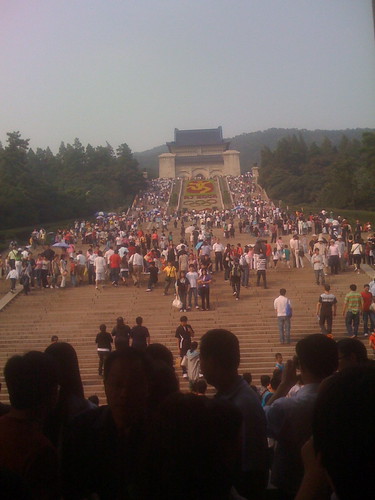
On National Day, October 1st, we climbed part of Purple Mountain, which is a big hill in an enormous park next to the city. We also visited Sun Yatsen’s mausoleum. He’s regarded as the father of modern China, so it was only appropriate to visit him on China’s national holiday, except for the dense crowds that day.
The rest of the week has been pretty slow. I have a cold and it’s rainy so I have done a whole other than study and read. A number of people stayed home because traveling at this time is not ideal (everyone has the same week off).


We visited the Nanjing Massacre Museum and Memorial. It was renovated a couple years ago. The events in Asia before and during World War II, outside of the United States and Japanese conflict, were relatively unknown to me. The history of the Japanese occupation of China was well documented. A timeline with pictures and newspaper articles traced the Japanese army as they moved west, through many places now familiar to me, including Taicang and Changzhou (which fell on November 29th).
On December 13th, 1937, the Japanese army reached Nanjing, which at the time was the base of the Kuomintang and the capital of the Republic of China. The museum houses artifacts and bones of the victims, news reports and diaries, including some by western teachers and professionals, and photographs, many of which were taken by the Japanese army. A lot of anger and resentment still linger over the massacre, and some of those emotions show up in the descriptions in the exhibits.
On National Day, October 1st, we climbed part of Purple Mountain, which is a big hill in an enormous park next to the city. We also visited Sun Yatsen’s mausoleum. He’s regarded as the father of modern China, so it was only appropriate to visit him on China’s national holiday, except for the dense crowds that day.
The rest of the week has been pretty slow. I have a cold and it’s rainy so I have done a whole other than study and read. A number of people stayed home because traveling at this time is not ideal (everyone has the same week off).
Subscribe to:
Posts (Atom)